ONE OF THE WORLD’S LARGEST QUICLINK PRODUCERS
Here, Quiclink is not a side product. With an annual production capacity of 10,000 tons, we produce it every day, not occasionally. This production volume makes possible the equipment investments we use, our process control and the quality consistency behind every coil we ship.
DESIGNED FOR HIGH-CARBON STEEL
Our wires are produced from steels with a carbon content of up to 0.90%. This is where strength comes from — and where most wire producers reach their limit. High-carbon steel work-hardens rapidly, resists drawing operations and exposes every weakness in the production line. A large part of our facility is designed specifically to process medium- and high-carbon steel, and all of our processes are optimized for this material group rather than compromising between different materials.
A MACHINE LINE SELECTED FOR THE LOAD
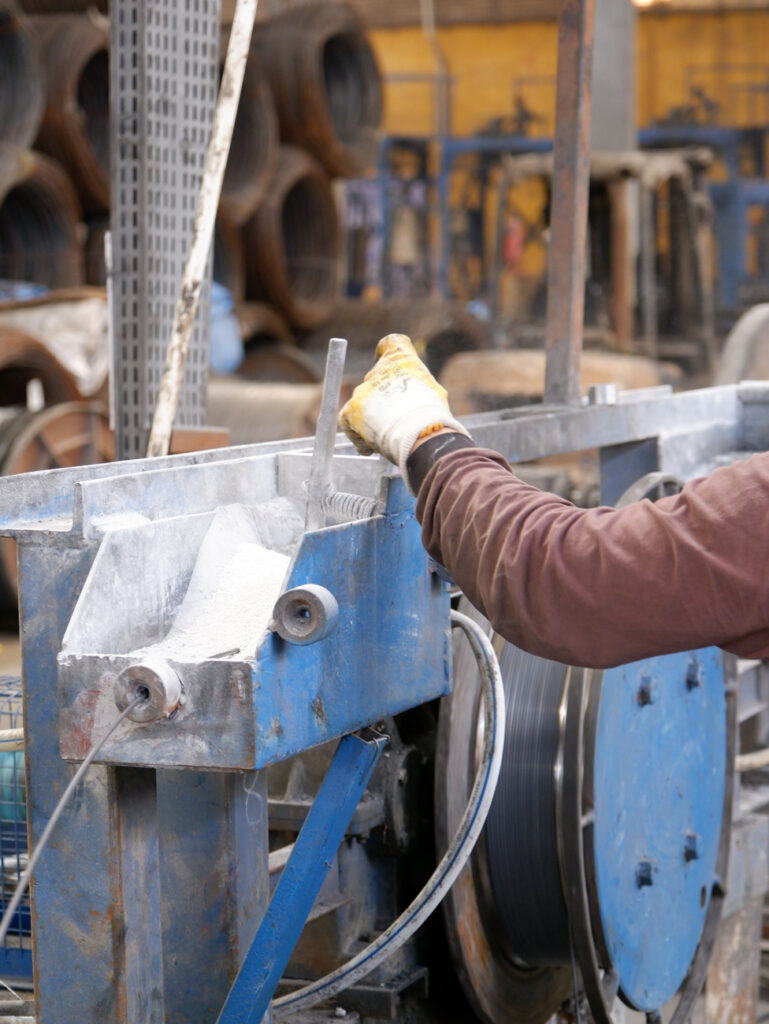
Drawing high-carbon wire requires higher force at every stage. That is why our equipment is designed accordingly: heavy machine frames that keep their alignment under load, drive systems with capacity far above what low-carbon wire production requires, hardened dies and tooling, and cooling capacity to control the heat generated by high deformation. In the production chain, no piece of equipment is a low-carbon machine forced to do high-carbon work. This lets us reach tensile-strength levels that cannot be achieved simply by buying the right wire rod.
COATING ON EVERY PRODUCT, AT OUR OWN FACILITY
Galvanizing and phosphating are carried out on our own production lines and applied across our entire product range. Phosphating in particular is not an optional step here; the lubricant-holding crystalline structure it forms makes possible the heavy deformation required for high tensile strength. When coating is outsourced, the manufacturer can control neither the quality nor the lead time of this critical stage on which the product depends.
THE COST IS NEVER THE WIRE ITSELF
A tie wire that fails does not just cost its own price. It can cause a bale to drop to the warehouse floor, a production line to stop mid-shift, or a load to be rejected on delivery. On the invoice, wire is a small line item; in risk management, it is a major one. Our production philosophy is shaped by this reality.
WE START FROM THE APPLICATION, NOT THE CATALOG
Bale density, the press used, the tying method, storage conditions and how far the load will travel directly affect the right wire selection. That is why we first analyze the application, then determine the diameter, quality class, coating and length. Instead of shipping the closest standard product, we prefer to produce the right one.
THE SAME WIRE ON THE TENTH ORDER AS ON THE FIRST
What separates a supplier from an ordinary seller is consistency. Diameter, tensile strength, elongation and coating properties are maintained at the same values from shipment to shipment. This way, a specification that runs on your line continues to deliver the same performance on subsequent orders.
PREDICTABLE SUPPLY
In high-volume baling operations, a late delivery means a stopped operation. Our production is planned according to committed orders, order status is traceable, and rather than giving the customer the date they want to hear, we prefer to share delivery dates we can actually meet.
DESIGNED FOR EXPORT, NOT ADAPTED AFTERWARD
Wires leaving Türkiye pass through weeks of transport and humid storage conditions before reaching the customer. Coating class, packaging and coil protection are determined according to this journey. We export mainly to European, African and Asian markets and work with customers all over the world.
FREQUENTLY ASKED QUESTIONS
WHICH PRODUCTS DOES BURMETAL OFFER?
Quiclink bale ties in oval and round profiles, single-loop and double-loop baling wires, rosette coils and custom industrial wires. Galvanized, phosphated and bright surface options are available across the entire product range.
WHICH SECTORS DO YOU SERVE?
We serve the recycling and waste management, packaging, textile, agriculture and general industrial manufacturing sectors.
HOW CAN I CHOOSE THE RIGHT BALING WIRE?
First, the material to be baled and its recovery characteristics should be evaluated. Flexible materials with a high tendency to spring back, such as plastic and textiles, require more elongation, while shape-retaining materials such as paper and cardboard allow the use of higher-tensile wires with a smaller cross-section. Next, the wire should be selected according to the machine to be used. Loop wires are used in vertical and closed-end horizontal presses, while rosette coils are preferred on automatic tying lines. Finally, the suitable coating is chosen according to storage and shipping conditions. If you share the material type, the machine and the bale dimensions, we can determine the appropriate specification.
WHAT IS THE DIFFERENCE WITH HIGH-CARBON WIRE?
A higher carbon ratio means higher tensile strength. This allows the same load to be carried with a smaller cross-section and less steel to be used per bale. Because it is more difficult to produce, our facility is designed specifically for this material class.
CAN YOU PRODUCE CUSTOM SIZES?
Yes. Diameter, tensile strength class, coating, cut length, form and packaging specifications can be produced according to customer requirements. If you share your technical requirements, we can confirm feasibility and lead time.
DO YOU OFFER RETAIL OR PRIVATE-LABEL PACKS?
Yes. Round Quiclink products can be offered as boxed retail packs, unboxed packs for distributors who apply their own packaging, or bundled flat wires.
DO YOU EXPORT?
Yes. We export to many countries around the world, mainly to Europe, Africa and Asia.