products
Loop Baling Wire
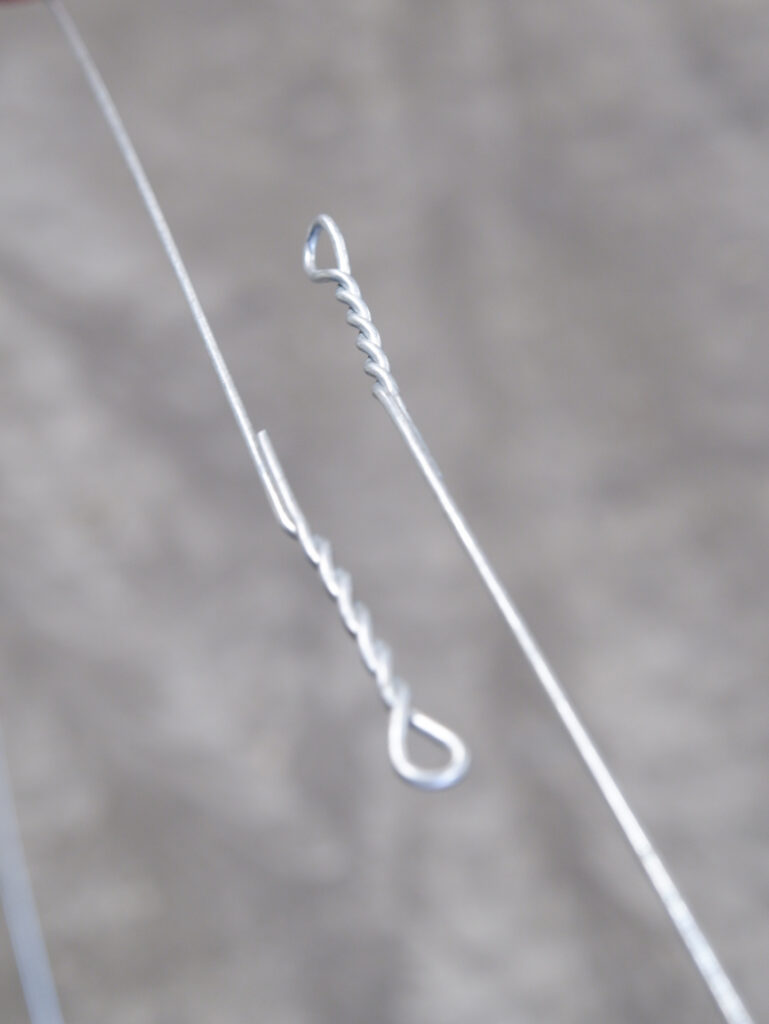
Loop baling wires are pre-cut tie wires with a formed loop on one or both ends. They are closed by hand around the bale — requiring neither tools nor knots.
They are the standard tying solution for vertical balers and closed-end horizontal balers, and remain the most widely used bale ties in the recycling industry worldwide. Burmetal produces both types.
Softness is part of the design. Both products are drawn from low-carbon steel and then annealed. Annealing removes the work hardening created during drawing and restores a soft, ductile grain structure. As a result, tensile strength is lower than that of high-tensile wires, but elongation is much higher — and that is exactly the intended property.
The wire bends around bale corners without breaking, holds its connection without springback, and stretches together with the bale as it expands after the press is opened; thus it absorbs the expansion instead of snapping at the connection point. The galvanized coating protects the surface in humid storage conditions, outdoor stockpiling and during sea freight.
SINGLE LOOP
There is one formed loop; the free end is passed through this loop and bent back over the wire to secure it. Because the operator sets the final tension by hand, a single wire length can be used for different bale sizes. It is the most commonly preferred option in applications where bale dimensions vary.
DOUBLE LOOP
There is a loop on each end; the two loops are hooked into one another and closed. No twisting tool is required, fewer motions are needed per bale, and the result is a repeatable lock whose quality does not depend on operator technique. It is a faster solution on high-capacity lines with fixed bale dimensions.
APPLICATIONS
Suitable for hand-tied low- and medium-density bales: cardboard and corrugated board (OCC), paper, plastic film, textiles, aluminum cans, foam materials and agricultural packaging. In these applications workability matters more than breaking load, and annealed low-carbon tie wires meet exactly this need.
Both types are supplied in a wide range of wire diameters and cut lengths, packed according to the quantities your operation uses.